Tag: authentication measures

  • Regulatory Fire: NIBSS Fault & Flutterwave’s ₦21B Glitch — A Wake-Up Call for Nigeria’s Fintech Space and a Call for Cybersecurity Reform

    Regulatory Fire: NIBSS Fault & Flutterwave’s ₦21B Glitch — A Wake-Up Call for Nigeria’s Fintech Space and a Call for Cybersecurity Reform

    In a rapidly digitizing financial ecosystem, trust and reliability are the lifelines that power fintech innovation. However, recent events have shaken confidence in Nigeria’s digital payment infrastructure. A staggering ₦21 billion ($14 million) “glitch” involving Flutterwave — Nigeria’s leading fintech unicorn — and the Nigeria Inter-Bank Settlement System PLC (NIBSS) has triggered serious regulatory concerns and public debate.

    What Happened?

    In early 2025, Flutterwave reported an alarming incident: unauthorized transactions totaling over ₦21 billion were processed due to a “technical fault.” At the heart of this fault lies NIBSS, the centralized platform responsible for processing interbank payments and ensuring transaction integrity across Nigeria’s financial system.

    Investigations suggest that the glitch originated from a vulnerability in the NIBSS infrastructure that allowed multiple fraudulent or duplicate transactions to be processed without being flagged or halted. This breakdown in control mechanisms enabled bad actors to exploit the payment pipeline, leading to massive fund losses across several Flutterwave-linked accounts.

    The Fallout

    As soon as the incident came to light, the Central Bank of Nigeria (CBN) launched an inquiry into the integrity of the systems operated by both NIBSS and Flutterwave. This was more than just a cybersecurity oversight — it raised existential questions about the reliability of Nigeria’s financial rails.

    Flutterwave responded by initiating legal action and working with law enforcement agencies to freeze hundreds of accounts where the stolen funds were funneled. While a large portion of the money has been recovered or traced, the glitch underscores deeper systemic risks in the nation’s payment infrastructure.

    NIBSS, often viewed as the digital backbone of Nigeria’s banking sector, has maintained a measured silence, issuing a brief statement indicating an “internal review” was underway. However, industry insiders suggest that a major overhaul of NIBSS’ transaction monitoring systems may be inevitable.

    Implications for the Fintech Industry

    This isn’t just about one incident — it’s a warning shot for the broader Nigerian fintech ecosystem.

    1. Trust Deficit

    Consumers and partners are increasingly wary. If the country’s largest fintech and national settlement system can be breached or misfire at this scale, smaller players might be even more vulnerable.

    2. Increased Regulatory Scrutiny

    The Nigerian government, already cautious about the explosive growth of fintechs, may now impose stricter regulatory requirements — from mandatory third-party audits to real-time reporting systems. Compliance costs are expected to rise.

    3. Investor Anxiety

    Global investors, especially those eyeing Africa’s fintech boom, may adopt a wait-and-see approach. The episode may prompt due diligence teams to assess infrastructure risk more critically.

    4. Collaborative Security Models

    This crisis could spark more collaboration among fintechs, banks, and regulators to build a more resilient cybersecurity framework — potentially leading to a sector-wide cybersecurity council or NIBSS reform task force.

    The Bigger Picture

    This incident mirrors a global pattern: as digital payments increase, so does the scale and sophistication of systemic risks. Nigeria’s situation is unique in that NIBSS is a centralized hub — any fault there has a ripple effect across the entire banking and fintech landscape.

    The path forward will require transparency, technical accountability, and proactive regulation. For Flutterwave, this is a defining moment — not only to restore its reputation but to lead the charge for a safer, more secure fintech ecosystem in Africa.

    Conclusion

    The ₦21 billion glitch is more than a financial mishap — it’s a wake-up call. Nigeria’s digital financial infrastructure must evolve not just in innovation, but in integrity and resilience. When trust breaks in a payment ecosystem, so does confidence in the entire financial system.

    This is where cybersecurity must take center stage.

    Implementing robust cybersecurity frameworks — such as those aligned with international standards like NIST Cybersecurity Framework or ISO/IEC 27001 — can help fintechs and financial institutions anticipate, detect, and respond to threats more effectively. Real-time fraud detection systems, enhanced encryption, continuous vulnerability assessments, and secure software development lifecycles should become non-negotiable.

    Moreover, incident response plans must be tested regularly, with clear roles and rapid communication channels between banks, fintechs, and regulators like the CBN. Cybersecurity isn’t just an IT concern; it is now a strategic and regulatory imperative.

    As digital finance continues to expand across Africa, integrating cybersecurity into every layer of operation is no longer optional — it’s essential. A proactive, collaborative, and security-first approach is the only way forward to ensure trust, stability, and growth in Nigeria’s booming fintech landscape.

    Media Disclaimer: This report is based on internal and external research obtained through various means. The information provided is for reference purposes only, and users bear full responsibility for their reliance on it. Summitsystemsissp assumes no liability for the accuracy or consequences of using this information

  • Trump Executive Order Rewrites U.S. Cybersecurity Playbook

    Trump Executive Order Rewrites U.S. Cybersecurity Playbook

    On June 6, 2025, President Donald Trump issued a sweeping Executive Order (EO) titled “Sustaining Select Efforts to Strengthen the Nation’s Cybersecurity.” It revises key aspects of both Biden-era EO 14144 (Jan 16, 2025) and Obama-era cybersecurity directives. The changes notably roll back digital identity initiatives and adjust how sanctions against cyber actors are applied.

    Narrowing Sanctions Authority

    • The EO restricts sanctions under existing cyber sanctions laws (e.g., EO 13694) to foreign malicious actors targeting critical infrastructure.
    • Sanctions will explicitly not apply in cases of election interference—even by foreign entities—unless they attack critical infrastructure
    • Critics warn the move potentially exempts foreign meddling in U.S. elections, raising accountability concerns

    Digital Identity Rollback

    • The EO scraps Biden’s digital identity provisions, which encouraged federal, state, and private sector deployment of remote identity verification (e.g., mobile driver’s licenses for accessing benefits)
    • According to the White House, this rollback aims to prevent the misuse of digital IDs for “entitlement fraud” by undocumented immigrants
    • Cybersecurity advocates caution that eliminating digital ID standards removes critical tools for reducing identity-related fraud and bolstering secure authentication frameworks

    Strengthening Core Cyber Tasks

    • The EO supports secure software development practices, mandating NIST, Commerce, and CISA to collaborate on standards for software integrity, timely patching, and supply chain security
    • It accelerates post-quantum encryption readiness, requiring the NSA and OMB to set encryption protocols resistant to future quantum threats by 2030
    • It directs agencies like DoD, DHS, ODNI, and NIST to develop frameworks to manage AI, IoT, and routing (BGP) vulnerabilities through stronger encryption and cross-agency coordination .

    What This Means

    1. Mixed Cybersecurity Signals
      While the EO strengthens some technical defenses (software hygiene, encryption, AI safeguards), the rollback of digital identity and narrowed sanctions may undermine long-term cyber resilience.
    2. Political vs. Technical Priorities
      The administration frames these rollbacks as removing “politically motivated” overreach—particularly around digital IDs and election-related sanctions—famously criticizing Biden’s EO as having “problematic and distracting issues”
    3. Implementation Concerns
      NIST, already affected by recent federal budget cuts, faces pressure to fulfill new mandates with fewer resources
      Meanwhile, ambiguous guidance on AI and IoT security may complicate adoption across federal agencies and the private sector.

    Expert Commentary

    • Mark Montgomery from the Foundation for Defense of Democracies warns: “The fixation on revoking digital ID mandates is prioritizing questionable immigration benefits over proven cybersecurity benefits”
    • Cybersecurity analysts note that while some reversals align with political rhetoric, they may weaken standardized approaches to identity verification and fraud prevention.

    Conclusion

    President Trump’s YOEO strikes a complex balance: enhancing technical safeguards like quantum-safe encryption and secure software, but also drawing back on digital identity programs and narrowing sanctions. This signals a pivot toward streamlined, infrastructure-focused cybersecurity, downplaying broader identity and election-related implications. Whether this approach will offer stronger resilience—or expose new vulnerabilities—depends heavily on agency follow-through, resource allocation, and potential Congressional response, especially concerning digital ID standards and election security.

    Media Disclaimer: This report is based on internal and external research obtained through various means. The information provided is for reference purposes only, and users bear full responsibility for their reliance on it. Summitsystemsissp assumes no liability for the accuracy or consequences of using this information
  • Critical OpenSSH Vulnerabilities Expose Systems to Man-in-the-Middle and DoS Attacks — Patch Immediately!

    Critical OpenSSH Vulnerabilities Expose Systems to Man-in-the-Middle and DoS Attacks — Patch Immediately!

    Critical OpenSSH Vulnerabilities Discovered

    Security researchers have recently disclosed multiple vulnerabilities in OpenSSH, the widely used open-source implementation of the SSH protocol. These flaws could allow attackers to launch Man-in-the-Middle (MitM) attacks and Denial-of-Service (DoS) attacks, putting countless systems at risk. Organizations relying on OpenSSH for secure remote access should immediately patch their systems to mitigate these threats.

    Overview of the Vulnerabilities

    The newly identified vulnerabilities affect OpenSSH versions prior to the latest security patch. The two most critical flaws include:

    1. Man-in-the-Middle Attack Vulnerability(CVE-2024-####)
      • Attackers can intercept SSH traffic, potentially decrypting session data or injecting malicious commands.
      • This flaw stems from improper validation of SSH handshake integrity, allowing adversaries to manipulate authentication processes.
    2. Denial-of-Service (DoS) Vulnerability(CVE-2024-####)
      • Malicious actors can send specially crafted SSH messages, causing excessive CPU and memory consumption.
      • This can lead to system crashes or service disruptions, affecting business operations.

    Potential Impact on Organizations

    If exploited, these vulnerabilities could have severe consequences:

    • Compromised Authentication: Attackers can intercept or alter authentication requests, leading to unauthorized access.
    • Data Theft & Manipulation: Sensitive data transmitted over SSH sessions could be exposed.
    • Service Disruptions: Critical services relying on SSH for secure communications could be rendered inoperable.

    Mitigation & Recommended Actions

    Summit Systems ISSP strongly advises organizations to take the following actions immediately:

    1. Patch OpenSSH Immediately
      • Upgrade to the latest OpenSSH version that addresses these vulnerabilities.
      • Check official OpenSSH repositories and security advisories for the latest patch details.
    2. Enable Strict SSH Configurations
      • Use strict key exchange algorithms and disable outdated cryptographic protocols.
      • Implement multi-factor authentication (MFA) to enhance access security.
    3. Monitor & Audit SSH Traffic
      • Regularly review SSH logs for unusual login attempts or anomalies.
      • Deploy intrusion detection systems (IDS) to identify suspicious SSH activity.
    4. Restrict SSH Access
      • Limit SSH access to only necessary users and IP ranges.
      • Implement firewall rules to prevent unauthorized SSH connections.

    Conclusion

    With the growing threat landscape, ensuring the security of OpenSSH implementations is critical. Organizations should act immediately by applying patches, strengthening security configurations, and monitoring SSH activity. Summit Systems ISSP remains committed to helping businesses stay ahead of cyber threats through proactive security strategies.

    Media Disclaimer: This report is based on internal and external research obtained through various means. The information provided is for reference purposes only, and users bear full responsibility for their reliance on it. Summitsystemsissp assumes no liability for the accuracy or consequences of using this information.

  • Microsoft Addresses Critical Authentication Bypass Vulnerability (CVE-2025-21396)

    Microsoft Addresses Critical Authentication Bypass Vulnerability (CVE-2025-21396)

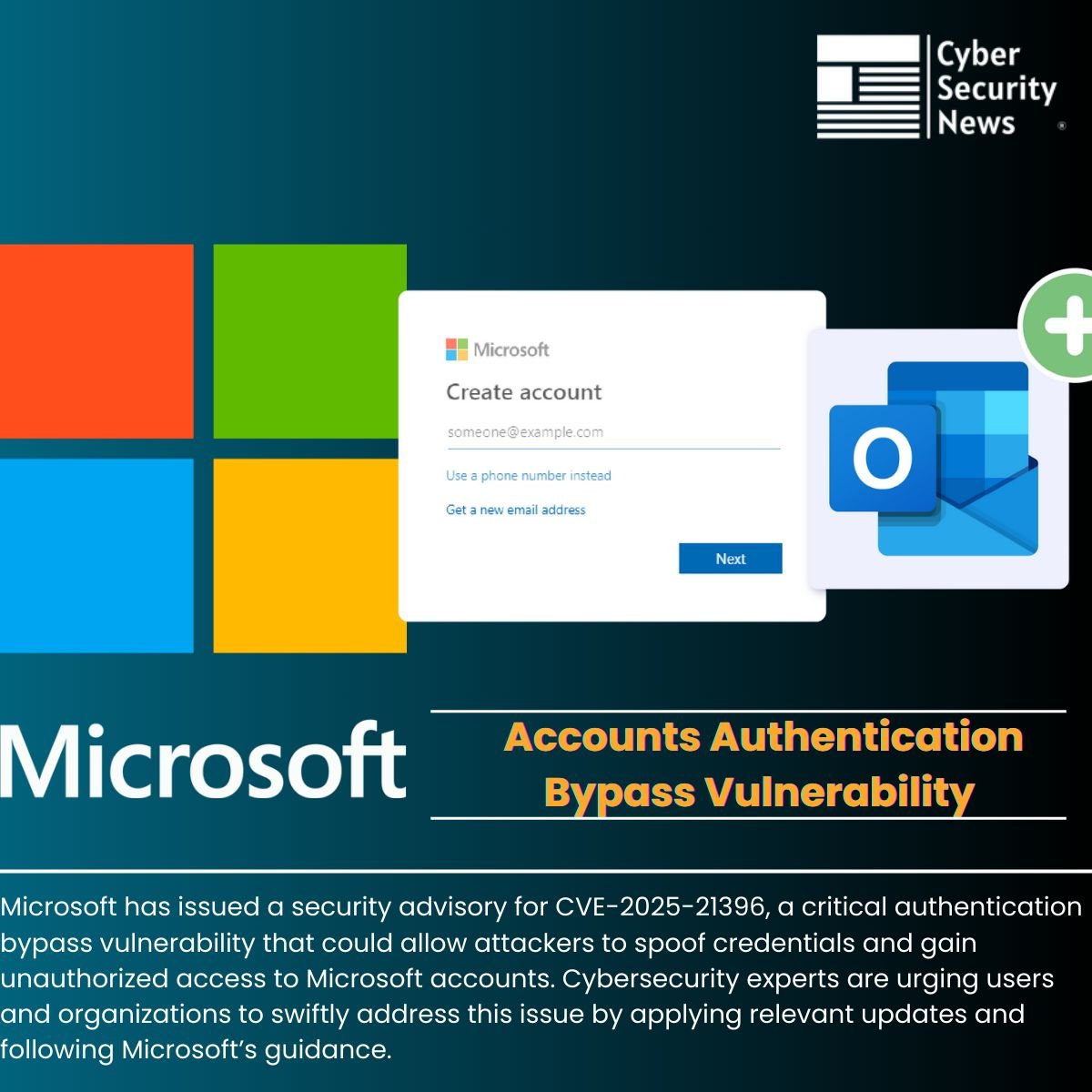
    In a crucial security update, Microsoft has issued an advisory for CVE-2025-21396, a critical authentication bypass vulnerability that could enable attackers to spoof credentials and gain unauthorized access to Microsoft accounts. Summit Systems strongly advises organizations and individuals to take immediate steps to mitigate the associated risks.

    Understanding CVE-2025-21396

    CVE-2025-21396 is associated with CWE-290 (Authentication Bypass by Spoofing), a recognized security weakness affecting authentication mechanisms that lack robust validation methods. Malicious actors can exploit trust-based authentication models using techniques such as:

    • IP Spoofing: Attackers forge source IP addresses to impersonate trusted systems and gain unauthorized access.
    • DNS Spoofing: Manipulating DNS responses to redirect users to attacker-controlled domains.
    • Malformed or Manipulated Requests: Exploiting weak validation logic in application-layer protocols to bypass authentication measures.

    Due to the prevalent reliance on IP and DNS-based trust models, this vulnerability poses a significant risk, necessitating immediate remediation.

    Attack Scenarios and Potential Impact

    The vulnerability may be exploited in multiple ways, including:

    • Bypassing IP-Based Authentication: Organizations that rely solely on IP addresses for authentication may be at risk, as attackers can forge IP addresses to appear as trusted entities, bypassing security measures.
    • DNS-Based Host Verification Manipulation: Attackers can poison DNS caches, causing systems to trust a malicious domain masquerading as a legitimate Microsoft service.

    Considering the relative ease of executing IP spoofing and DNS cache poisoning attacks, CVE-2025-21396 is classified as a critical vulnerability with a high likelihood of exploitation.

    Microsoft’s Security Guidance & Recommended Mitigations

    Microsoft has issued patches to address CVE-2025-21396 and urges all users and organizations to apply security updates without delay. Summit Systems further recommends the following best practices:

    1. Apply Security Updates: Regularly update all systems and software by following Microsoft’s Security Update Guide.
    2. Strengthen Authentication Mechanisms:
      • Implement Multifactor Authentication (MFA) for enhanced security.
      • Utilize cryptographic tokens for secure identity validation.
      • Deploy Mutual TLS (mTLS) for encrypted and authenticated connections.
    3. Monitor Networks for Anomalies: Deploy Intrusion Detection Systems (IDS) to detect spoofed packets and unusual DNS activity.
    4. Harden DNS Infrastructure: Implement DNS Security Extensions (DNSSEC) to safeguard against DNS spoofing and maintain data integrity.
    5. Enable Logging & Auditing: Maintain comprehensive logs of authentication attempts to facilitate forensic analysis in the event of an attack.

    While Microsoft has addressed CVE-2025-21396 with the latest security updates, organizations must take proactive measures such as strengthening authentication frameworks and enhancing network monitoring to reduce exposure to similar threats in the future.

    Media Disclaimer: This report is based on internal and external research obtained through various means. The information provided is for reference purposes only, and users bear full responsibility for their reliance on it. Summitsystemsissp assumes no liability for the accuracy or consequences of using this information.

  • Massive PowerSchool Data Breach Exposes Millions of Student and Educator Records

    Massive PowerSchool Data Breach Exposes Millions of Student and Educator Records

    The education sector is facing one of the most significant data breaches in recent history, as PowerSchool, a leading provider of Student Information Systems (SIS) in the U.S. and Canada, confirmed that hackers had stolen vast amounts of historical data from school districts. The breach, which has already impacted millions of students and educators, raises serious concerns about data security in educational institutions.

    On January 7, 2025, PowerSchool disclosed that attackers had accessed its SIS service through the PowerSource customer support portal. This breach enabled them to steal extensive personal data, including:

    • Names and contact information
    • Dates of birth
    • Medical records
    • Social Security numbers
    • Disability information
    • Race, ethnicity, and gender data
    • Parent/guardian/emergency contact details

    School districts confirmed that records dating back to 1985 were compromised, impacting over 72 million individuals, including 62.5 million students and 9.5 million educators across the U.S. and Canada.

    How Did This Happen?

    PowerSchool initially cited a “compromised credential” as the entry point for the breach. The Menlo Park City School District (MPCSD) reported that the compromised credential belonged to a maintenance account, granting broad access to customer data. Security researchers suspect that information-stealing malware may have been used to obtain this login information.

    The breach was detected on December 28, 2024, but evidence suggests that hackers had been exfiltrating data since December 22 using an export data manager. Despite working with cybersecurity firm CrowdStrike to investigate the breach, PowerSchool has not publicly disclosed further details about the attack.

    A Growing Crisis: Lawsuits and Fallout

    As more school districts reveal the extent of their data exposure, legal and reputational consequences for PowerSchool continue to mount:

    • Over 20 lawsuits have already been filed against the company.
    • School districts, including the Toronto District School Board (TDSB), reported that 1.5 million students were affected.
    • Data from 6,500 school districts may have been stolen, making this one of the largest education sector breaches to date.

    Despite claims that the stolen data was deleted after a ransom payment was made, PowerSchool is providing impacted individuals with two years of free identity theft and credit monitoring services.

    What Can Schools and Educators Do?

    Given the scale of this breach, affected institutions and individuals must take proactive steps to protect their data:

    1. Review Security Logs – Schools using PowerSchool’s SIS should analyze logs to determine the extent of data exfiltration.
    2. Monitor for Identity Theft – Impacted individuals should take advantage of PowerSchool’s credit monitoring offer and watch for suspicious activity.
    3. Strengthen Authentication Measures – Institutions should implement multi-factor authentication (MFA) and regularly rotate administrative credentials.
    4. Enhance Cybersecurity Training – Educators and administrators should be trained on recognizing phishing attempts and safeguarding sensitive information.

    Final Thoughts

    This breach highlights the urgent need for stronger cybersecurity measures in the education sector. Schools must reassess their security strategies to prevent future incidents, and vendors like PowerSchool must ensure that their systems are more resilient against cyber threats. Summit Systems is committed to helping organization bolster their cybersecurity defenses through advanced risk management strategies and compliance solutions.

    Media Disclaimer: This report is based on internal and external research obtained through various means. The information provided is for reference purposes only, and users bear full responsibility for their reliance on it. Summitsystemsissp assumes no liability for the accuracy or consequences of using this information.